




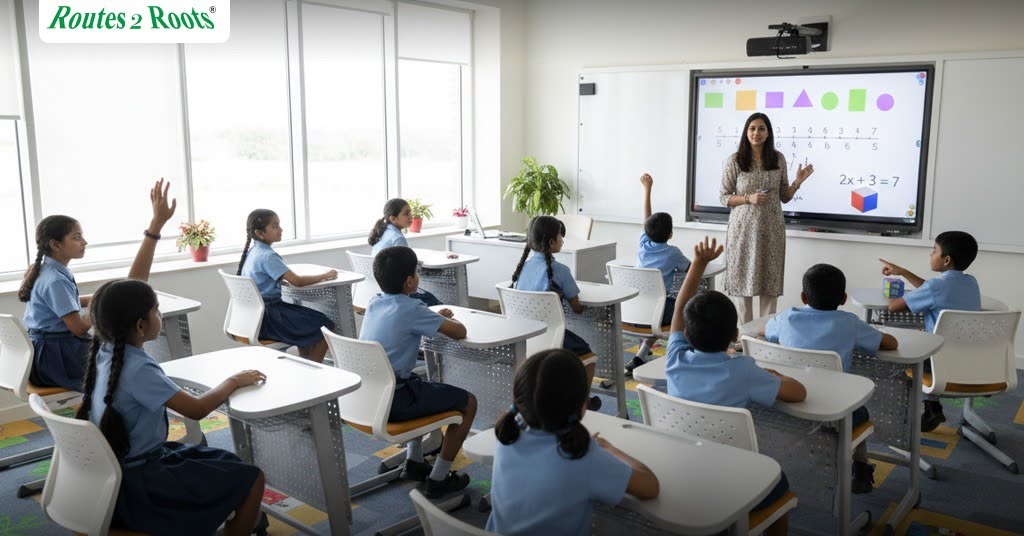
Science and mathematics are often regarded as the most difficult academic subjects by a large number of students. A combination of technology and education is making STEM education in India more interactive, fun, and easier to grasp. Complex formula, intricate concepts, as well as conventional teaching methods are the major reasons why students find these subjects difficult. Also they feel away and disconnected from their daily life.
Consequently, learners lose their interest or find it hard to keep pace. Nevertheless, the story is making progress in the right direction with the rise of smart classrooms in schools.
Why STEM Feels Difficult for Students
Traditionally, science and math have been known to demand conceptual understanding instead of mere memorization. However, educational teaching in traditional schools still relies mostly on the use of textbooks and verbal explanations,
For example, without the correct visualization, one can view algebra geometry physics, or chemistry as a set of unintelligible and intangible concepts. This lack of understanding has an impact on students’ engagement in the classroom. As a result, there is decreased interest and lack of confidence among students.
Hence in this situation, education has to transform from passive learning to interactive learning in schools where students can visualize, understand, and experience the concepts more lucidly.
The Role of Smart Classrooms
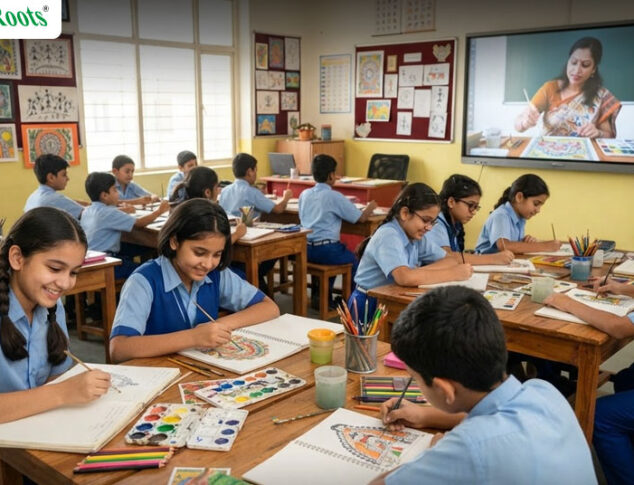
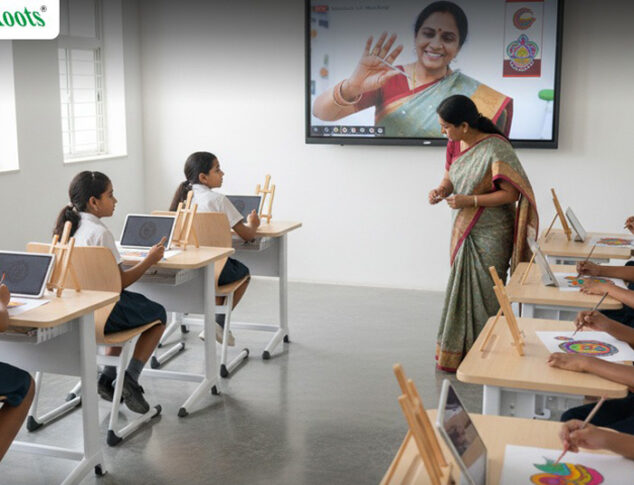
Digital classrooms in India are transforming the way teachers teach STEM subjects. Smart Interactive Panels, multimedia content, and real-time demonstrations help bring concepts to life.
Instead of imagining how a scientific process works, students can watch animations, simulations, and experiments unfold visually. This approach supports visual learning in classrooms, making it easier for students to grasp even complex ideas.
For example:
-
Geometry becomes clearer with visual diagrams and interactive shapes
-
Physics concepts like motion and force can be demonstrated through simulations
-
Mathematical problems can be solved step-by-step with dynamic explanations
This shift from abstract to visual learning makes a significant difference in comprehension.
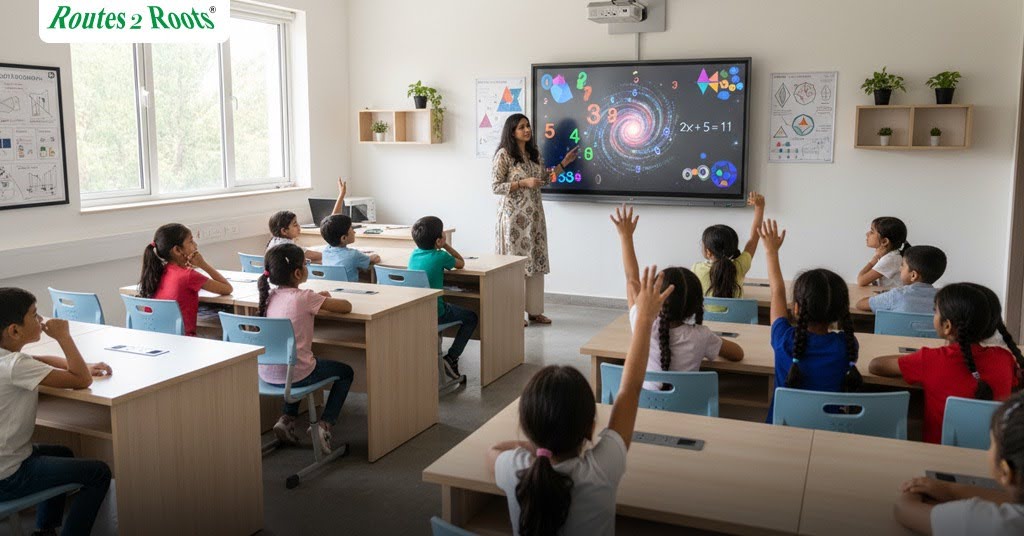
Making Science Easy to Understand
Smart classrooms are really good at making complicated topics simpler. For example, a science lesson that might be hard to understand can become very simple by using videos, animations, and interactive tools. Students then get the possibilities to:
1. Watch very interesting experiments which are not physically possible in a classroom.
2. Understand the difficult points of the topic by dividing them into smaller and clear parts.
3. Get a chance for learning at their own speed through repeated visual explanations.
This leads to better understanding, and also to the development of a desire to know more and liking the subject.
Simplifying Math Concepts
Why does math usually scare students? Because for them the math formula is not at par with reality. Smart classrooms attempt to solve this issue by breaking down math concepts into easy and relatable parts.
By means of smart tools students will be able to:
1. See math forms and curves
2. Get acquainted with the show you work out a problem
3. Get knowledge into their everyday life
Learning this way not only a student’s attitude towards math will change but also the student will start conceiving math as a rational and fascinating subject which is also understandable.
Boosting Student Engagement
As lessons become more interactive, students naturally become more involved. Smart classes raise student engagement levels by pushing for more participation and arousing curiosity.
Rather than just listening, students:
1. Are more inquisitive and ask more questions
2. Engage in discussions
3. Display a heightened interest in learning
This hands-on involvement results in deeper understanding and better academic outcomes.
Improving Learning Outcomes
The ultimate goal of education is to ensure meaningful understanding. By integrating technology in education, smart classrooms play a crucial role in improving learning outcomes.
Students who learn through visual and interactive methods are more likely to:
-
Retain information longer
-
Apply concepts effectively
-
Perform with greater confidence
This creates a stronger foundation for future learning, especially in STEM fields.
The Role of Routes 2 Roots
Organizations like Routes 2 Roots are helping bring this transformation to schools by introducing smart classrooms in schools along with structured teacher training.
Their approach ensures that technology is not just installed, but effectively used to enhance learning. By supporting interactive learning in schools, they are making STEM education more accessible and engaging for students across regions.
Looking Ahead
In a world that is ever more influenced by science and technology, the need to enhance STEM education in India is at its peak.
Making the learning of science and math comprehensible, to a large extent, is the smartest feature of smart classrooms. They enable students to do self-research and experimentation that not only lead to greater understanding but foster qualites of curiosity, cooperation, and love of learning.
Indeed, the key to turning education from mere academics into a stepping stone to the future is student’s deep comprehension of the subject matter.